
Role Concept, creative direction, research and editorial.
Context An open reference on web design history, independently researched and published. Developed in collaboration with Claude (Anthropic).
Duration August 2026 to present, ongoing publication.
Volume Ten eras, 53 movements, 267 glossary terms, 110 period screenshots, 82 sourced notes, an AI analyzer, a comparison tool and ten era-specific skins.
Nomenclature as a precondition for critique
Critical discussion of interface design depends on a shared terminology. In its absence, evaluation is limited to impressionistic judgments, such as “dated” or “modern”, that cannot be verified by a third party. Recurring visual patterns frequently precede the terms used to describe them, and a considerable portion of contemporary interface vocabulary remains informal or undocumented.
With Interwebs Intermaps I address this gap by applying the organizational model of art history to web interfaces: a chronological sequence of eras, subdivided into movements, supported by a glossary and by primary visual evidence. The project is intended to function as a reference and study resource.
Structure
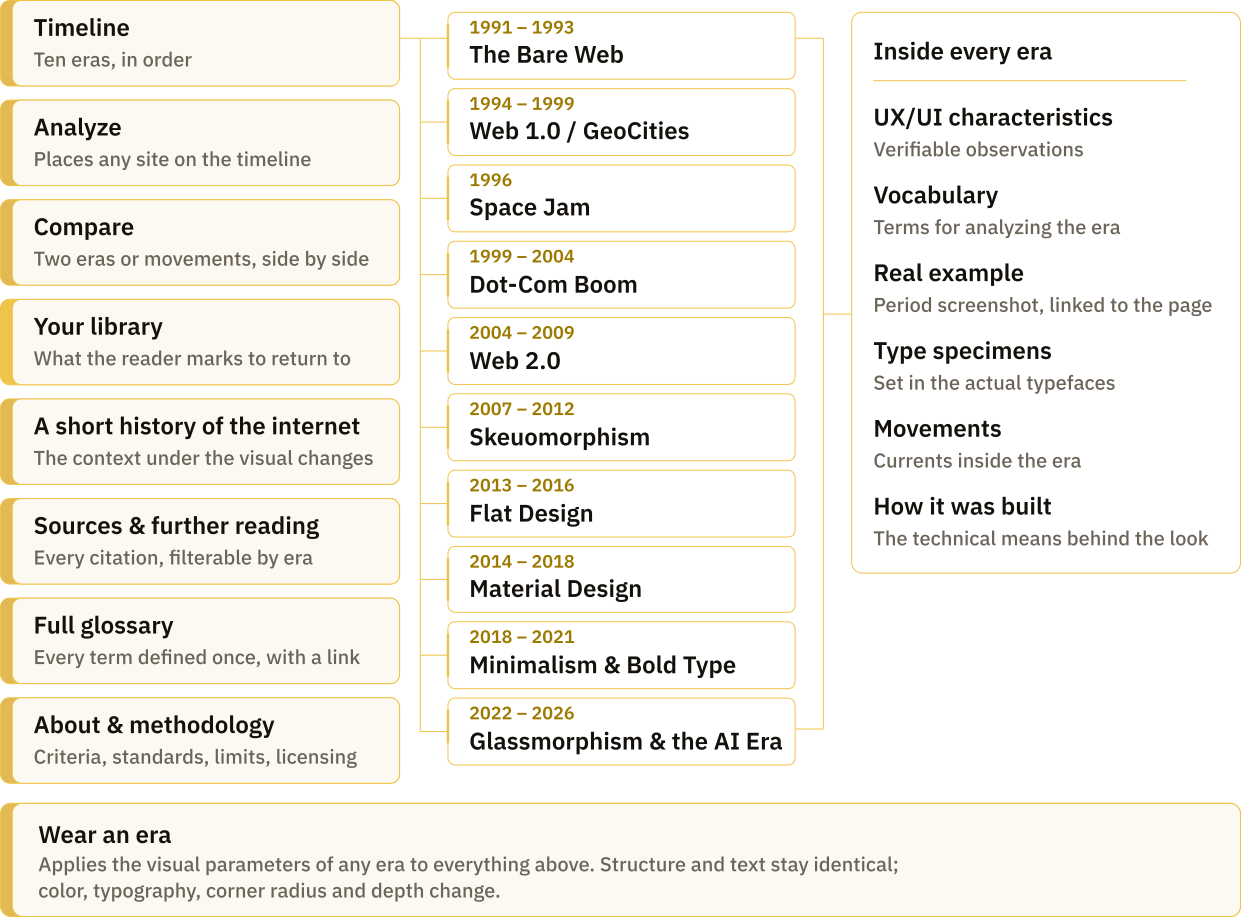
Timeline. The core of the project. Each era contains its UX/UI characteristics, analytical vocabulary, a period screenshot with a link to the archived original, the styles and approaches that recur within it, a description of how interfaces of that era were built, and the movements running inside it, each at its own address. Where the era has them, typographic specimens are set in the actual typefaces of the period.
Analyze. A tool that places any website on the timeline, described in its own section below.
Compare. A side-by-side view of any two eras or movements and their defining screenshots.
Your library. A personal collection of the eras and terms each reader marks for later reference.
A short history of the internet. A parallel chronology of the technical and economic conditions (networks, browsers, investment, standards) that made each visual paradigm possible.
Sources & further reading. Every citation in the project in a single bibliography, filterable by era.
Full glossary. Every term used in the project, defined once, each with its own permanent link.
About & methodology. The classification criteria, the evidentiary standards, the declared limitations, the terms of the collaboration and the licensing of the work.
Taxonomy: era and movement
The central methodological decision of the project concerns classification rather than content. I define an era as the dominant visual paradigm of a given period. Within each era, I distinguish two kinds of entry. A movement is a current with enough identity to be treated as a subject in its own right, such as a regional platform, a countercultural aesthetic, or a tool whose influence diverged from the mainstream, and it has its own page. A style or approach is a recurring pattern of the period, recorded within the era’s page rather than as an independent subject.
Within “Web 2.0” (2004 to 2009), the hand-edited profile pages of MySpace are recorded as a style of the era, and Cyworld as a movement. Both answer the same demand, a personal page that reflects its owner: one through unrestricted HTML and CSS, the other through a designed and monetized system.
The periodization, the boundaries between eras and the criteria that distinguish a movement from a style constitute the principal argument of the work. Individual entries are revisable. The taxonomic structure determines how all of them are interpreted.
Evidentiary standards
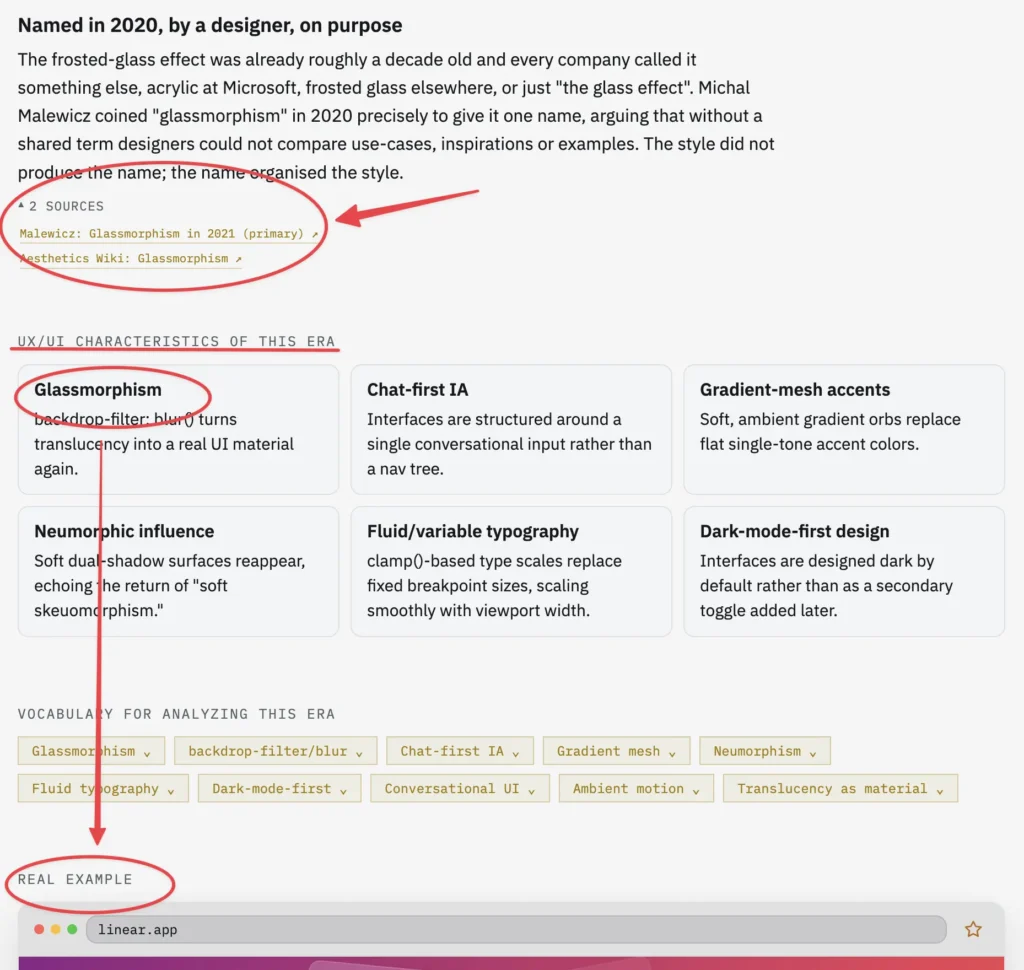
The entries are divided into two categories:
- A characteristic is a descriptive observation verifiable through direct inspection of a screenshot.
- A note is a historical assertion (a date, an attribution, an origin) and requires a citation.
A citation is admitted only after the cited document has been consulted in full, never on the basis of search results alone. This criterion is particularly relevant in AI-assisted research, where fabricated and legitimate references are indistinguishable without verification. A complete audit of the 82 sourced notes identified four errors, all of which were corrected.
Visual evidence is subject to an equivalent standard. All screenshots are hosted locally and correspond to the period they represent, the majority obtained from the Internet Archive’s Wayback Machine. I exclude captures that reflect later versions of a page, regardless of image quality.
The analyzer: testing the taxonomy
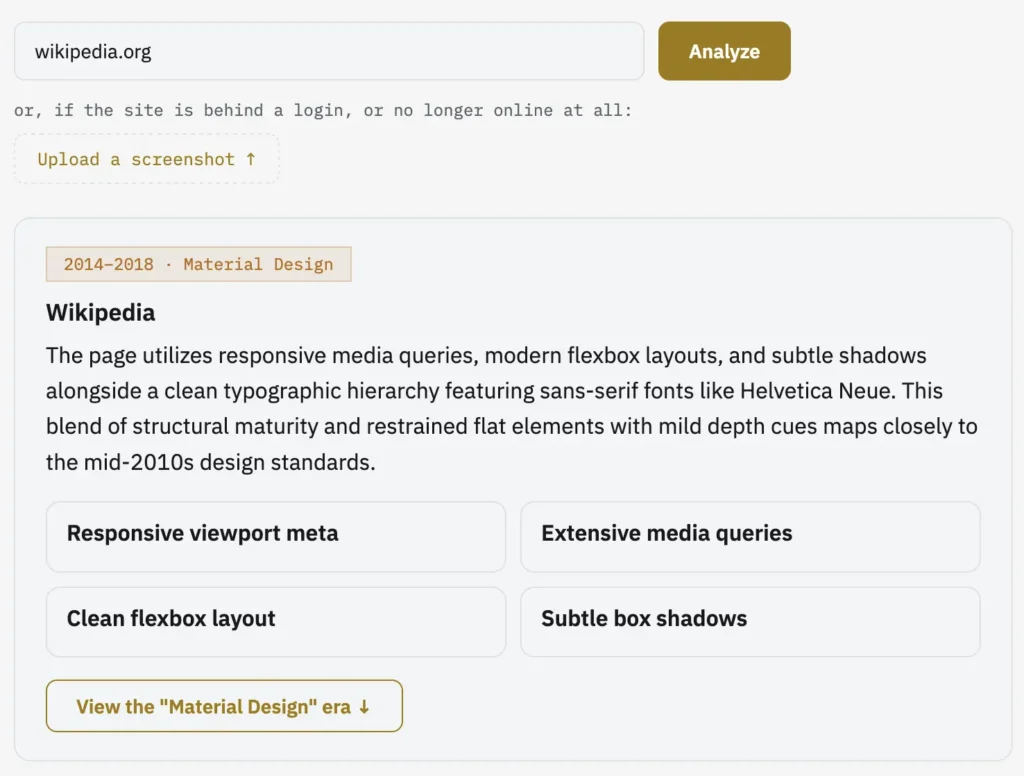
The analyzer places any website on the timeline and, in doing so, tests whether the characteristics recorded for each era are sufficient to classify an interface not included in the project.
It offers two methods. The first is a questionnaire in which the user describes observable features of a design; the answers are matched against the characteristics of each era. It requires no account, no connection to an external service and no cost. The second submits a URL, or a screenshot in the case of pages behind a login or no longer online, to a language model that returns a classification according to the same taxonomy.
Requests to the model are processed on the server, so that no credentials are exposed in the browser, and are subject to caching and rate limiting. Model identifiers are configurable settings rather than fixed values, since the names of available models become obsolete within months.
Wear an era
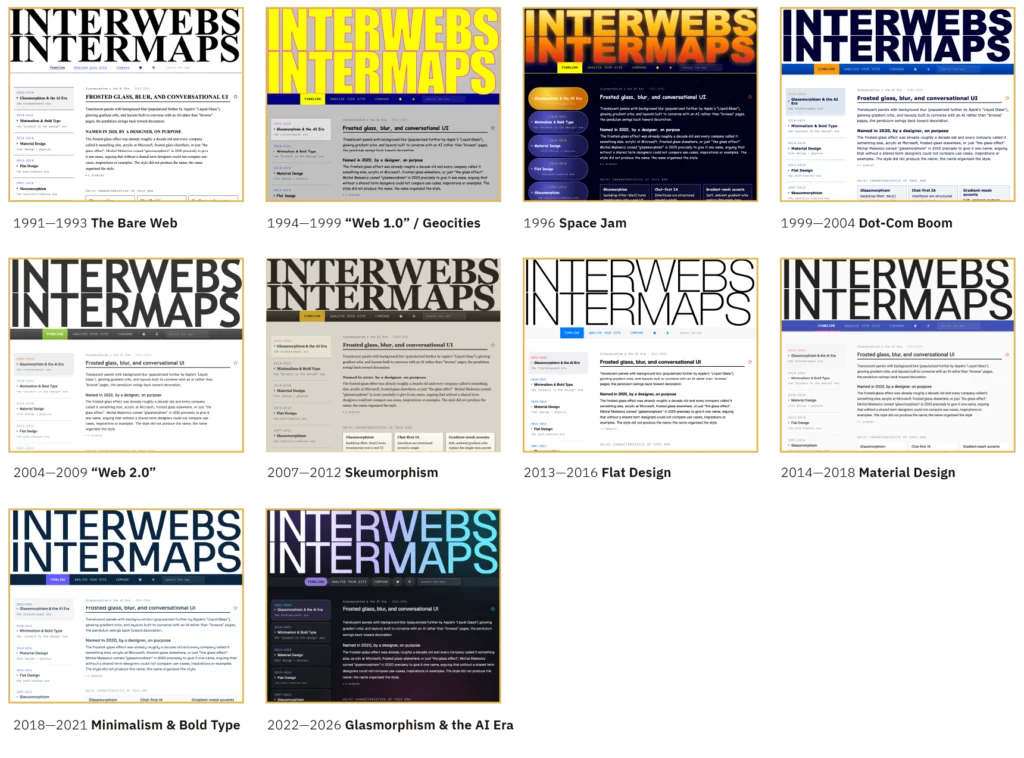
This feature applies the visual parameters of each period to the project itself, keeping structure and text identical. The altered variables are limited to color, typography, corner radius and depth.
The feature functions as a controlled comparison: content remains constant and only style varies. That these four variables are sufficient to make each era recognizable suggests they account for a significant proportion of what is commonly identified as an era’s visual identity.
Scope and declared bias
The chronological backbone follows the Western, predominantly Silicon Valley-centered sequence around which most design historiography is organized. Regional developments, among them Minitel in France, Orkut and Nubank in Brazil and Cyworld in South Korea, are classified as movements within that sequence rather than as autonomous eras.
I consider this a structural limitation and document it as such in the project’s methodology. Its explicit declaration establishes the boundaries of the work’s validity and defines the scope of subsequent revision.
Editorial control in AI-assisted work
I developed the project in collaboration with Claude, a language model by Anthropic. Implementation and a substantial part of the source research were performed by the model. Conceptual definition, editorial decisions and final approval of every interface remained my responsibility.
The working method consisted of iterative cycles: proposal by the model, evaluation on the target device, precise description of the observed result, and correction. Two procedures proved decisive. The first was requiring a causal diagnosis for each defect prior to its correction, which reduced recurrence. The second was reverting to previous versions whenever increased complexity compromised stability.
Maintenance as editorial method
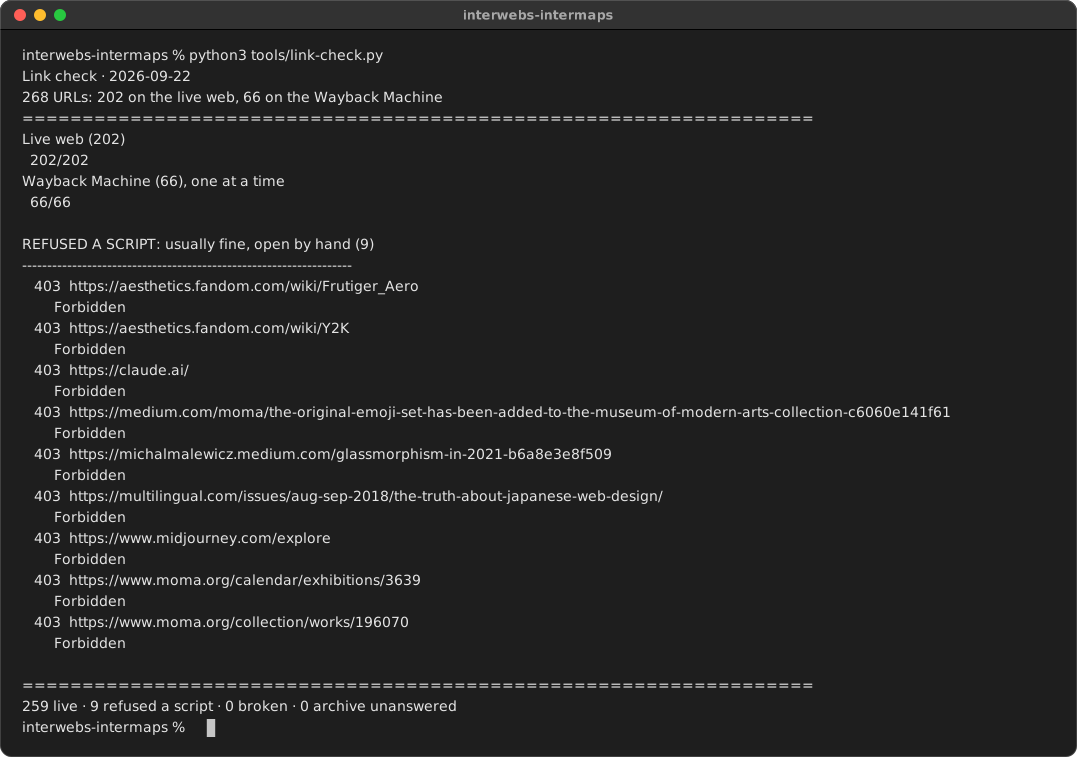
The principal risk in a historical reference of this kind is the publication of claims before they are fully understood. Hyperlinks degrade, archived captures become unavailable, and new sources may alter the content of an entry. I therefore treat the project as a continuous publication, supported by a watchlist of claims under review, periodic link verification, automated audit scripts and documentation that permits independent maintenance.
The written content, selection and arrangement of the project are licensed under CC BY-NC-SA 4.0, and the source code under the MIT licence. Screenshots remain the property of their respective owners and are reproduced for commentary and study. The intention is for the map to remain open to use, citation and extension, and for its gaps to be treated as the agenda for future work.

